
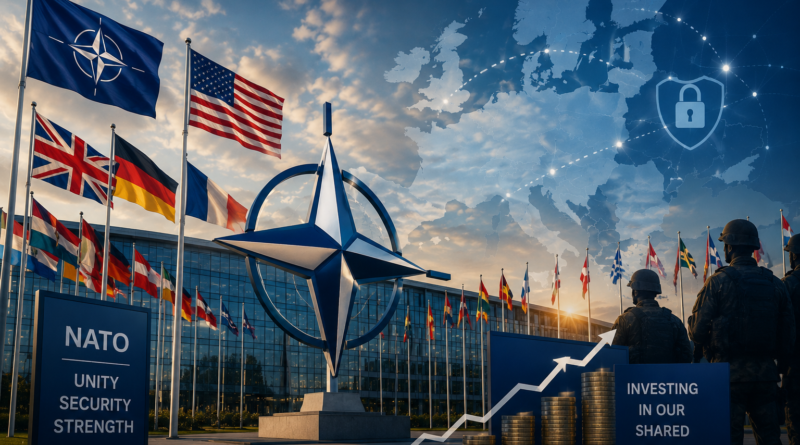
NATO Seeks Unity as US Presses Europe on Security Spending Ahead of Summit
NATO is trying to show unity ahead of its upcoming summit as the United States continues to push European allies to increase security spending and take greater responsibility for regional stability.
The issue has become one of the most important topics in transatlantic relations. Washington wants European countries to contribute more, while European governments are trying to balance security commitments with domestic economic pressure.
NATO Secretary General Mark Rutte recently met US President Donald Trump in Washington as part of preparations for the next alliance summit. The meeting highlighted the importance of keeping the United States and Europe aligned at a time when global security challenges are becoming more complex.
Why the summit matters
The upcoming NATO summit is expected to focus on unity, long-term planning and member contributions.
For the United States, the central message is clear: Europe should do more to support the alliance. American officials have repeatedly argued that the burden should not fall too heavily on Washington.
For European countries, the challenge is more complicated. Many governments support stronger security planning, but higher spending can create budget pressure at home. Public services, inflation, debt management and political divisions all affect how fast countries can increase their commitments.
This makes the summit important because it may define how NATO shares responsibility in the coming years.
Europe faces pressure to step up
Several European governments have already increased security-related budgets or announced future plans to do so. However, the pace differs from country to country.
Eastern European members generally support faster increases because they see regional stability as an urgent priority. Some Western European countries are moving more carefully because of budget limits and domestic political concerns.
The United States is likely to continue pressing allies to move faster. Washington wants NATO to become less dependent on American resources and more capable of handling regional challenges with stronger European participation.
Rutte’s balancing role
Mark Rutte’s role is especially important because he must keep both sides focused on alliance unity.
His message to Washington is that Europe is stepping up. His message to Europe is that US support cannot be taken for granted without stronger commitments from allies.
This balancing act is central to NATO’s future. If the alliance appears divided, it could create uncertainty for governments, investors and global partners. If it shows unity, it may strengthen confidence in transatlantic cooperation.
Economic impact of security spending
The debate is not only about policy. It also has an economic side.
Higher security spending can support industries linked to technology, manufacturing, logistics, cybersecurity and advanced research. It can also create new contracts for companies across Europe and North America.
At the same time, governments must decide how to pay for these commitments. Some may increase borrowing, adjust public budgets or redirect existing spending.
This is why the NATO spending debate is closely watched by both political leaders and financial markets.
What it means for the United States
For the United States, stronger European contributions could reduce long-term pressure on American resources. It could also allow Washington to focus more attention on the Indo-Pacific, trade competition, supply chains and technology policy.
At the same time, US leadership remains central to NATO. European countries still rely heavily on American strategic support, intelligence cooperation and advanced capabilities.
This means Washington wants more contribution from allies, but NATO still depends on US leadership to remain fully effective.
What to watch next
There are three major points to watch before and during the summit.
First, whether NATO members announce new spending commitments.
Second, whether the United States signals confidence in European efforts.
Third, whether the alliance presents a clear message of unity despite internal pressure.
For now, NATO is entering the summit with one major goal: prove that the United States and Europe can remain aligned while sharing more responsibility for the future of transatlantic security.