
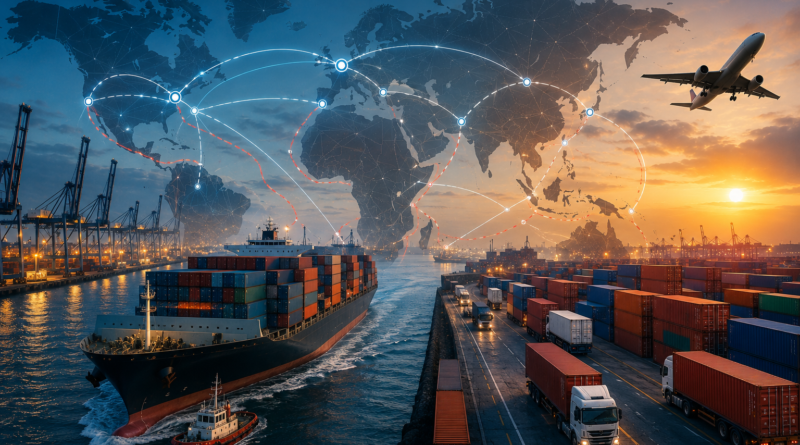
Global Shipping Costs Rise as Companies Rework Trade Routes in 2026
Global shipping costs are rising again as companies adjust to changing trade rules, tariff uncertainty and pressure on key maritime routes.
The latest movement in freight markets shows how closely global trade depends on predictable shipping lanes, stable policy and smooth customs systems. When companies expect higher tariffs or delays, many move goods earlier than planned. This can create a sudden rise in demand for ships, containers and port capacity.
For businesses, the result is simple: international trade is becoming more expensive and more difficult to plan.
Why shipping costs are rising
One major reason is frontloading. Many companies are bringing goods into major markets earlier to avoid possible tariff changes or supply-chain delays. When too many importers do this at the same time, demand for container space rises quickly.
Shipping companies then raise prices because vessel space becomes limited. Ports may also face heavier traffic, which can slow movement and add extra costs.
This pattern is especially important for retailers, electronics companies, auto-parts suppliers and consumer-goods brands. These businesses depend on predictable delivery schedules and stable transport costs.
Trade routes are becoming more strategic
For decades, global trade was mainly about cost efficiency. Companies wanted the cheapest supplier, the fastest route and the lowest storage cost.
That model is now changing.
Businesses are paying more attention to route safety, customs rules, port reliability and political risk. A cheaper route is no longer always the best option if it creates uncertainty.
This is why many companies are now building more flexible supply chains. They are using multiple suppliers, alternative ports and backup shipping routes to reduce risk.
The role of tariffs
Tariffs remain one of the biggest concerns for global traders in 2026.
When governments introduce or discuss new tariffs, companies often react before the rules officially change. Importers may increase orders early, store more inventory or shift suppliers to different countries.
This creates short-term pressure on shipping markets. It can also affect prices for consumers if companies pass higher costs into final products.
For small and medium-sized businesses, tariff uncertainty can be especially difficult because they have less room to absorb sudden cost increases.
Why this matters for consumers
Shipping costs affect everyday products more than many people realise.
Electronics, clothes, furniture, medicines, food items, machinery and vehicle parts all depend on global logistics. When freight costs rise, businesses may face higher import costs. Over time, that can influence retail prices.
Consumers may not immediately see the change, but companies often adjust prices, delivery timelines or product availability when logistics costs remain high.
This is why shipping is not only a business issue. It is also a household economy issue.
Asia, Europe and the US remain central
Asia remains the world’s most important manufacturing region, while the United States and Europe remain two of the largest consumer markets.
Because of this, shipping routes connecting Asia with North America and Europe are closely watched. Any increase in freight rates on these routes can affect global trade data, company earnings and retail supply.
At the same time, emerging economies are trying to benefit from supply-chain diversification. Countries in South Asia, Southeast Asia and the Middle East are positioning themselves as alternative manufacturing and logistics hubs.
Technology is changing logistics
Technology is also becoming more important in global shipping.
Companies are using AI tools, real-time tracking, digital customs platforms and predictive analytics to manage trade risk. These tools help businesses track cargo, estimate delays, compare routes and plan inventory more efficiently.
However, technology cannot remove all uncertainty. It can only help companies respond faster and make better decisions.
This is why businesses are combining digital tools with more diversified supply chains.
What to watch next
There are four key points to watch in global shipping and trade.
First, whether freight rates continue rising or cool down after early shipments are completed.
Second, whether tariff discussions create more uncertainty for importers.
Third, whether major shipping routes remain stable and predictable.
Fourth, whether companies continue shifting toward flexible supply-chain models.
For now, global shipping remains under pressure, but the bigger story is not only about higher freight costs. It is about how world trade is changing from a low-cost model to a risk-aware model.
Companies that adapt quickly may protect their margins better. Countries that improve ports, customs and logistics systems may become more attractive in the next phase of global commerce.