
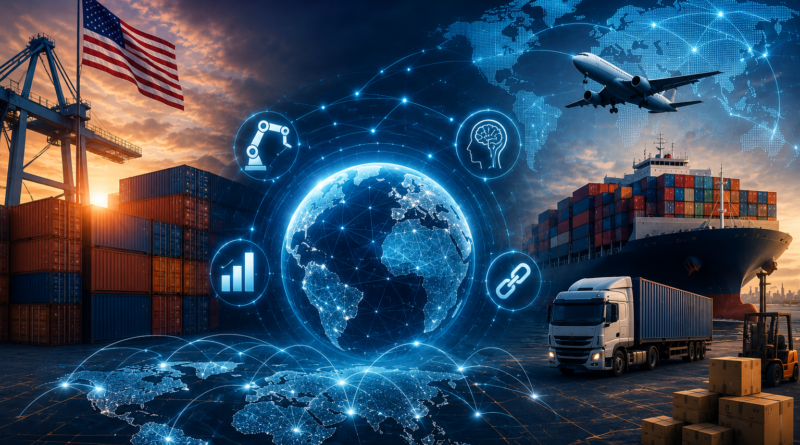
World Trade Enters a New Phase as Tariffs, AI and Supply Chains Reshape Global Commerce
World trade is entering a new phase in 2026 as countries, companies and investors adjust to changing tariffs, new technology demand and shifting supply-chain strategies.
After a stronger-than-expected performance in 2025, global trade growth is expected to slow this year. However, the slowdown does not mean global commerce is weakening completely. Instead, trade is becoming more selective, more regional and more influenced by technology, policy and strategic industries.
The biggest change is that governments are no longer treating trade as only an economic issue. Trade is now closely connected to national competitiveness, technology leadership, energy security and industrial policy.
Global trade remains large, but growth is slowing
Global trade reached record levels in 2025, supported by goods, services and strong demand for technology-related products. But the pace is expected to become more moderate in 2026 as higher costs, policy uncertainty and changing supply routes affect business decisions.
For companies, this means global expansion is still possible, but it requires more careful planning. Businesses now need to think not only about price and demand, but also about tariffs, regulations, shipping routes, data rules and supplier reliability.
This is especially important for small and medium-sized exporters, which often face higher pressure when compliance costs rise.
Tariffs are no longer the only trade challenge
Tariffs remain an important part of global trade policy, but they are not the only challenge. Many exporters now face non-tariff measures such as technical standards, product certifications, environmental rules, safety requirements and documentation procedures.
These rules can make trade more complex even when tariff rates are low. For large companies, compliance can be managed with legal and technical teams. For smaller businesses, the same rules can become a major barrier.
This is one reason trade agreements are changing. Modern trade talks are no longer only about reducing tariffs. They increasingly focus on aligning standards, simplifying customs procedures and making rules easier to understand.
AI and digital industries are supporting trade growth
One of the strongest areas of global trade is linked to artificial intelligence, semiconductors, cloud infrastructure, data centres and advanced electronics.
Demand for AI-related goods has created new momentum in manufacturing and technology supply chains. Countries that produce chips, servers, electronics, cooling equipment and digital infrastructure components are benefiting from this shift.
This trend is also changing trade priorities. Governments want reliable access to advanced technology, while companies want diversified suppliers for critical components.
As a result, AI is not only changing how businesses operate. It is also changing what the world trades.
Supply chains are becoming more diversified
Companies are increasingly trying to avoid depending too much on a single country or region. This has created opportunities for “connector economies” that act as manufacturing, logistics or assembly hubs between major markets.
Countries in Southeast Asia, South Asia, the Middle East and parts of Africa are trying to attract investment by offering lower costs, better logistics and access to growing consumer markets.
This does not mean globalisation is ending. Instead, globalisation is becoming more distributed. Companies still want international markets, but they want more flexibility and lower exposure to sudden policy changes.
Developing economies see both opportunity and pressure
For developing countries, the new trade environment creates both opportunity and difficulty.
On one side, supply-chain diversification can bring investment, jobs and export growth. Countries with improving infrastructure, young workforces and stable policy environments may benefit from companies looking for new production bases.
On the other side, developing economies often face higher compliance costs, limited financing and weaker export infrastructure. If global rules become more complex, smaller exporters may struggle to compete.
This is why trade transparency, digital customs systems and better certification support are becoming important for developing economies.
Why world trade matters for consumers
World trade affects everyday life more than many people realise.
It influences the price of electronics, fuel, medicines, food products, clothing, vehicles and household goods. When trade costs rise, companies may pass some of those costs to consumers. When supply chains work smoothly, prices and availability become more stable.
Trade also affects jobs. Export industries support employment in manufacturing, logistics, technology, agriculture, finance and services. A shift in global trade patterns can create new opportunities in some countries while creating pressure in others.
What to watch next
There are four major points to watch in world trade this year.
First, whether tariff pressure increases or countries return to more stable trade talks.
Second, whether AI-related demand continues to support electronics and semiconductor trade.
Third, whether supply chains keep moving toward more diversified production networks.
Fourth, whether developing countries can reduce trade costs and attract more global investment.
For now, world trade is not collapsing. It is changing. The countries and companies that adapt fastest to this new phase may become the biggest winners in the global economy.