
Mamdani July 4 Immigration Speech Puts Immigration at Center of America 250 Debate
New York City Mayor Zohran Mamdani used an Independence Day address to highlight immigration, national identity, and the meaning of American belonging. The Mamdani July 4 immigration speech was delivered on July 3, 2026, ahead of the United States’ 250th Independence Day celebrations. It came as political leaders across the country used the anniversary to present different views of American history and the nation’s future.
Mamdani did not mention President Donald Trump by name. However, several parts of the speech appeared to respond to the president’s immigration policies and public messaging, according to reports from The Associated Press and CBS New York.
The address matters because immigration remains one of the most debated issues in American politics. It also matters because New York City has long presented itself as a gateway for newcomers. Today, about 3.1 million New Yorkers are foreign-born, making up 38% of the city’s population, according to the Center for Migration Studies.
Why the Mamdani July 4 Immigration Speech Drew Attention
The speech took place during America 250, the national commemoration of 250 years since the Declaration of Independence. Across the country, the anniversary mixed celebration with political reflection. Some leaders focused on military strength, national pride, and American exceptionalism. Others used the moment to discuss inequality, civil rights, and the unfinished promises of the nation’s founding.
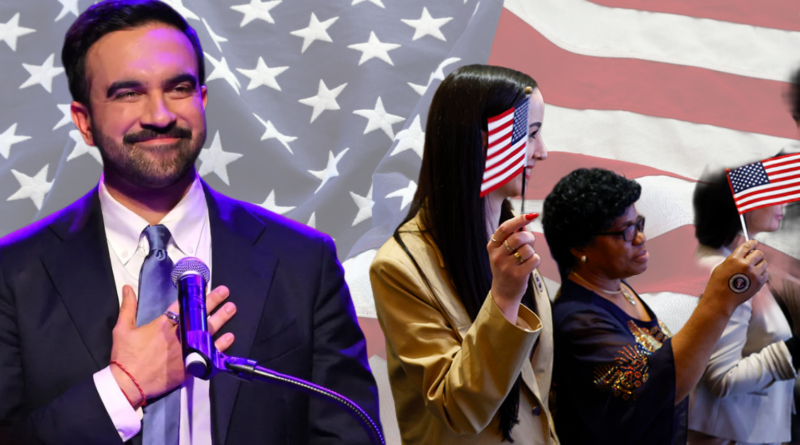
Mamdani spoke at New York City Hall from behind a desk associated with George Washington. He was joined by recently naturalized citizens, a visual choice that placed immigration at the center of the address. The Guardian reported that Mamdani used the setting to connect New York’s immigrant history with the country’s founding ideals.
His personal background also shaped the public reading of the speech. The New York State Assembly biography says Mamdani was born in Kampala, Uganda, moved to New York City at age seven, and became a naturalized U.S. citizen in 2018.
What Mamdani Said
The main message of the speech was that immigrants have helped shape New York and the United States. Mamdani pointed to different immigrant communities that arrived in New York over generations. He framed their story as part of the larger American story, not separate from it.
CBS New York reported that Mamdani criticized leaders who, in his view, see immigration as a threat rather than a strength. He argued that the country’s founding ideals remain active only when people continue to expand them in practice.
The speech also included criticism of immigration enforcement. Mamdani referred to fear in immigrant neighborhoods and described federal enforcement in sharply negative terms. These comments were part of the address’s broader argument that America should be judged by how it treats vulnerable people.
At the same time, Mamdani presented his remarks as a form of patriotism. He said love of country can include criticism of its failures. CBS reported that he framed dissent and reform as part of America’s democratic tradition.
Different Political Viewpoints
Supporters of Mamdani’s message are likely to view the speech as a defense of immigrants and a reminder of New York’s history. They may argue that immigration has helped build the city’s economy, culture, workforce, and civic identity.
They may also see the speech as a call to protect due process. In plain terms, due process means that people should receive fair legal treatment before the government takes serious action against them.
Critics saw the speech differently. The Washington Examiner described the address as heavily focused on criticism of wealthy elites, immigration authorities, and political leaders. It also noted that Mamdani delivered the remarks while contrasting his message with Trump’s expected Independence Day address at Mount Rushmore.
Some critics may argue that July 4 speeches should focus more on unity, national achievement, and shared pride. Others may say Mamdani’s remarks were too ideological for a national anniversary.
Both views reflect a wider divide in U.S. politics. One side often stresses border control, national sovereignty, and enforcement. The other side often stresses immigrant rights, humanitarian protection, and inclusion.
Why It Matters for New York and the U.S.
The Mamdani July 4 immigration speech matters because immigration policy affects everyday life in New York. It touches schools, workplaces, housing, public safety, courts, and local services.
New York City’s immigrant population is large and diverse. The Center for Migration Studies says immigrant New Yorkers are not a single group. They differ by language, legal status, job, education, income, and length of time in the United States.
This makes immigration policy both personal and practical. For example, city officials must consider how enforcement affects mixed-status families. These are households where people may have different immigration statuses.
The debate also affects businesses. Many sectors in New York rely on immigrant labor, including home health care, taxis, construction, food service, cleaning, and private household work, according to the same migration research.
Nationally, the speech adds to a broader debate about what Independence Day should represent. For some Americans, July 4 is mainly a day of celebration. For others, it is also a time to ask whether the country is meeting its stated ideals.
Risks, Challenges, and Concerns
The main challenge with political speeches on immigration is that they can deepen division. Strong language can energize supporters, but it can also alienate critics.
Another challenge is the gap between symbolism and policy. Speeches can shape public debate, but they do not automatically change federal immigration law. Cities can set local priorities, but immigration enforcement remains largely a federal responsibility.
There is also a risk of oversimplifying a complex issue. Immigration policy involves border management, asylum rules, labor demand, family unity, public spending, legal backlogs, and security concerns. A fair debate should address all these areas without reducing people to political symbols.
Mamdani’s supporters may say his speech humanized immigrants. Critics may say it gave too little attention to enforcement concerns. Both responses are part of the current political divide.
What Could Come Next
The speech could strengthen Mamdani’s profile among voters and activists who favor a more welcoming immigration approach. It may also increase criticism from conservatives and moderates who want stronger enforcement or less ideological language during national events.
The address could also influence local debate in New York City. City agencies, advocacy groups, and community organizations may use the speech to renew discussion about sanctuary policies, legal support, and immigrant access to public services.
However, the speech alone is unlikely to settle policy disputes. Immigration remains a federal issue with local effects. Therefore, future developments will likely depend on court rulings, federal enforcement priorities, congressional action, and city-level responses.
The most likely result is continued debate. Mamdani’s speech offered one view of America’s promise. Critics offered another view of what patriotism should emphasize. The political conversation may continue well beyond July 4.
Conclusion
The Mamdani July 4 immigration speech placed immigration at the center of America’s 250th Independence Day conversation. Mamdani used the moment to defend immigrants, criticize enforcement-heavy policies, and argue that patriotism can include public criticism.
The address did not name Trump directly, but reports said it clearly responded to the president’s immigration agenda and rhetoric. Supporters may see the speech as inclusive and historically grounded. Critics may see it as too critical for a national celebration.
The larger issue is not only one speech. It is the continuing national debate over immigration, identity, security, rights, and belonging. As the United States marks 250 years of independence, that debate remains one of the clearest signs that the country is still arguing over how to define its founding promises.