
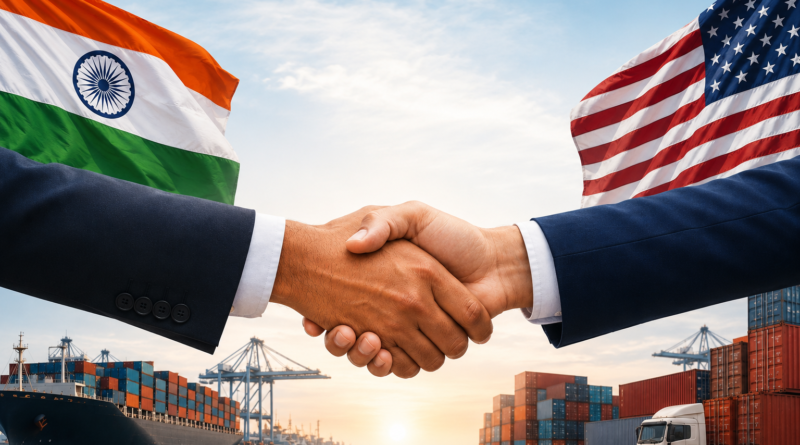
India and US Move Closer to Interim Trade Deal as Talks Gain Momentum
India and the United States appear to be moving closer to an interim trade agreement, a development that could reshape business ties between two of the world’s largest economies.
The talks have gained attention because both countries are looking for a balanced framework that supports exports, investment, technology cooperation and long-term economic partnership. For India, better access to the US market is a major priority. For the United States, the focus is on creating a fair and reciprocal trade arrangement.
The latest round of discussions involved Indian Trade Minister Piyush Goyal and US Trade Representative Jamieson Greer. Both sides have been working on a possible interim agreement that could act as a bridge toward a larger bilateral trade deal in the future.
Why the deal matters
India and the United States already have a strong economic relationship, but both sides believe there is room for major growth.
A trade agreement could help Indian exporters in sectors such as textiles, gems and jewellery, pharmaceuticals, engineering goods, food products and technology services. It could also support American companies looking for a larger role in India’s fast-growing consumer and manufacturing markets.
For India, the agreement is important because the US is one of its biggest trade partners. Better market access could help Indian businesses become more competitive globally.
For Washington, closer trade ties with India support a broader strategy of building stronger economic partnerships in Asia.
Focus on fair and balanced trade
The central issue in the talks is balance.
India wants preferential access for its goods and services, while the United States wants better market opportunities for American businesses. Both countries are trying to find a middle path that protects domestic industries while expanding trade.
This is not only about tariffs. The discussions may also involve supply chains, digital trade, standards, investment rules and regulatory cooperation.
A successful interim agreement could build confidence and create a foundation for a wider deal later.
Technology and supply chains
Technology is likely to be one of the most important areas in the India-US economic relationship.
Both countries are already working together in areas such as semiconductors, artificial intelligence, clean energy, defence manufacturing, digital services and advanced research. A stronger trade framework could make these partnerships easier by reducing uncertainty for businesses.
Global companies are also looking for more diverse supply chains. India wants to position itself as a major manufacturing and innovation hub, while the United States is trying to reduce overdependence on single-country supply networks.
This makes the trade talks important not only for both governments, but also for global companies planning future investment.
What it means for India
For India, a trade deal with the United States could support jobs, exports and manufacturing growth.
Sectors such as textiles, electronics, pharmaceuticals, agriculture and services may benefit if the agreement improves access to the US market. Small and medium-sized businesses could also gain if trade procedures become simpler and more predictable.
However, India will also need to protect sensitive sectors and ensure that domestic businesses are not placed under sudden pressure.
This is why negotiators are likely to move carefully.
What it means for the US
For the United States, a trade deal with India could open new opportunities for American companies in one of the world’s fastest-growing major economies.
US businesses are interested in India’s consumer market, digital economy, energy sector, infrastructure projects and technology ecosystem.
A stronger trade arrangement could also support Washington’s broader goal of building reliable economic partnerships in the Indo-Pacific region.
What to watch next
There are three key things to watch in the coming weeks.
First, whether both sides officially announce an interim trade agreement.
Second, whether the deal includes tariff relief or improved market access for major export sectors.
Third, whether the interim deal becomes the first step toward a larger India-US trade pact.
For now, the talks show that India and the United States are trying to turn their strategic partnership into a stronger economic partnership. If the agreement moves forward, it could become one of the most important trade developments of 2026.