US Warns China Is Pressuring States and Businesses Over Taiwan Engagement
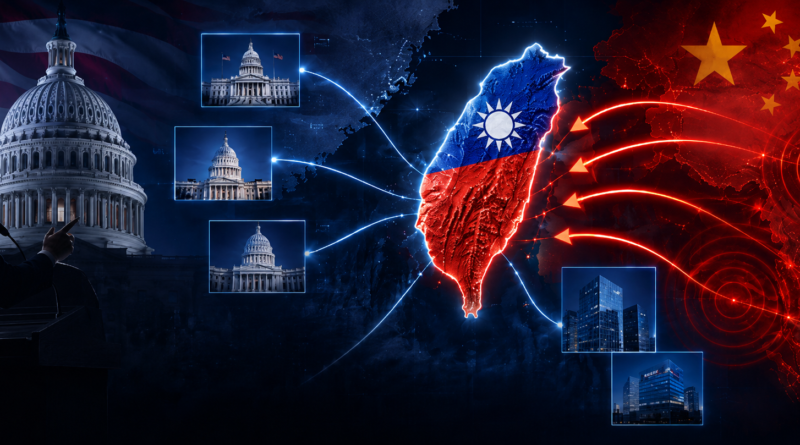
The United States has warned state governors and business leaders that China is trying to discourage American engagement with Taiwan, adding a new layer to the already sensitive relationship between Washington, Beijing and Taipei.
The warning shows how Taiwan has become more than a federal foreign-policy issue. It is now also affecting state governments, companies, trade groups and local business networks across the United States.
According to international reporting, US officials have told American states and businesses to be alert to pressure from Chinese representatives. The concern is that Beijing may try to influence how US companies and local governments interact with Taiwan by presenting its own interpretation of US policy.
Why this issue matters
Taiwan plays an important role in global technology, trade and supply chains. It is especially important in the semiconductor industry, which supports smartphones, computers, cars, defence systems and artificial intelligence infrastructure.
Because of this, US-Taiwan business ties are closely watched by governments and companies around the world. Any pressure on these ties can affect investment decisions, technology cooperation and long-term supply-chain planning.
For Washington, the issue is also about protecting the right of American businesses and state governments to maintain economic and cultural connections with Taiwan.
The United States does not have formal diplomatic relations with Taiwan, but it maintains strong unofficial ties. This balance has been part of US policy for decades. The latest warning suggests Washington wants to make sure local governments and private companies understand that engagement with Taiwan remains allowed under US policy.
China’s position
China views Taiwan as one of its most sensitive issues and strongly objects to foreign actions that appear to treat Taiwan as separate from Beijing’s authority.
Chinese officials have often criticised foreign meetings, trade visits and public statements involving Taiwan. Beijing argues that such engagement sends the wrong signal and goes against its position on sovereignty.
However, Taiwan’s government rejects Beijing’s claims and continues to build trade, technology and cultural partnerships with countries around the world.
This difference is the core reason Taiwan remains one of the most delicate issues in US-China relations.
A state-level foreign policy challenge
The latest US warning is important because it focuses on state governments and businesses, not only the White House or Congress.
In recent years, US states have increasingly pursued their own international trade relationships. Governors, mayors and business groups often meet foreign officials, sign investment agreements and promote local industries abroad.
This means foreign-policy pressure can now appear at the local level. A company considering a Taiwan partnership, or a state planning a trade visit, may face diplomatic messages from Chinese representatives.
By warning governors and business leaders, Washington is trying to prevent confusion and make clear that US policy does not block engagement with Taiwan.
Business and technology impact
The issue is especially important for technology companies. Taiwan is home to some of the world’s most important chip manufacturers, making it a key partner for industries linked to AI, electronics, cloud computing and advanced manufacturing.
The United States has been working to strengthen semiconductor supply chains and reduce overdependence on any single region. But Taiwan remains central to the global technology system.
If political pressure affects business cooperation, it could create uncertainty for companies planning investment, research partnerships or supply-chain expansion.
For investors, this is not only a diplomatic issue. It is also a market issue.
What to watch next
There are three major points to watch in the coming weeks.
First, whether US states and companies publicly report more pressure related to Taiwan engagement.
Second, whether Washington issues stronger guidance for business groups and local governments.
Third, whether China responds with public criticism or new diplomatic messaging.
For now, the Taiwan issue remains one of the biggest tests in US-China relations. The latest warning shows that the competition between Washington and Beijing is no longer limited to national capitals. It is also moving into boardrooms, state offices and local economic partnerships.