
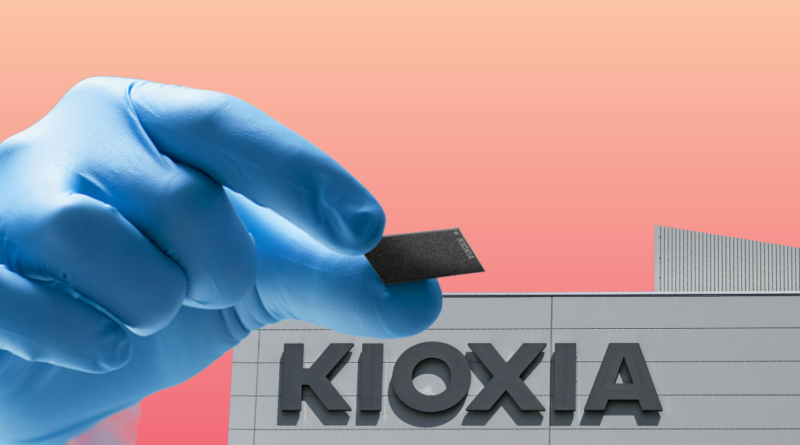
Kioxia Ships Next-Generation Memory Samples as AI Demand Drives Major Turnaround
Kioxia has started shipping samples of its next-generation flash memory, marking a key moment for the Japanese chipmaker as artificial intelligence reshapes the storage market. The development highlights the growing Kioxia AI memory boom, where demand from AI data centers is giving NAND flash memory a new role in modern computing.
The company announced sample shipments of 1Tb Triple-Level-Cell memory devices based on its 10th-generation BiCS FLASH 3D flash memory technology on July 3, 2026. These chips are mainly intended for enterprise and data center SSDs, where faster and more efficient storage is becoming more important for AI workloads.
The timing matters because AI systems need more than powerful processors. They also need fast storage to move, save, and retrieve large amounts of data. As a result, memory companies such as Kioxia are gaining fresh attention from cloud providers, data center operators, and technology investors.
What Kioxia Does
Kioxia is a Japanese memory company focused on flash memory and solid-state drives. Its predecessor, Toshiba Memory, was spun off from Toshiba in 2017. Toshiba is also widely linked to the invention of NAND flash memory in 1987.
NAND flash is the type of memory used in SSDs, smartphones, laptops, data centers, and many embedded devices. Unlike DRAM, which needs power to keep data, NAND can store data even when a device is turned off.
For years, NAND memory went through sharp market cycles. Prices often rose when demand was high and fell when supply expanded too quickly. Kioxia also faced pressure during weaker memory pricing periods. However, the AI boom has changed the discussion around advanced storage.
At first, much of the AI hardware conversation focused on GPUs and high-bandwidth memory, also known as HBM. HBM is a form of DRAM used close to processors for very fast data access. However, as AI use expands from model training to everyday inference, storage demand is also rising. Inference means the stage where an AI model responds to user prompts or business tasks.
This shift has helped create the current Kioxia AI memory boom.
Kioxia Ships 10th-Generation BiCS FLASH Samples
Kioxia said it has begun sample shipments of 1Tb TLC devices using 10th-generation BiCS FLASH technology. TLC means Triple-Level Cell. In simple terms, it stores three bits of data in each memory cell, allowing higher storage density than older designs.
The new products are expected to support enterprise and data center SSDs. These are storage drives used in servers, cloud platforms, and large computing systems. Kioxia said the technology is designed to meet demand for higher performance, higher capacity, and lower power consumption in AI storage.
The company plans to manufacture the new products at its Kitakami Plant Fab2 facility in Iwate Prefecture, Japan. Kioxia and Sandisk also announced the start of production for their 10th-generation 3D flash memory technology at Fab2. The companies said the facility supports the ongoing buildout of manufacturing infrastructure for NAND flash demand.
Reuters reported that Kioxia held a ceremony at its northern Japan fab as the company began shipping next-generation memory samples. The report also noted that Kioxia developed the 10th-generation BiCS Flash memory with Sandisk.
This does not mean every product using the new memory is already available at scale. Kioxia notes that these samples are for functional checks, and final mass-production specifications may differ.
How the New Memory Works
Kioxia’s 10th-generation BiCS FLASH is a form of 3D NAND. In older flat memory, cells sat mainly on a two-dimensional surface. In 3D NAND, memory cells are stacked vertically. This allows companies to fit more storage into a smaller area.
The new generation uses 332 layers and improves lateral density. Kioxia says this increases bit density by 59% compared with its 8th-generation technology. Bit density means how much data can fit in a given chip area.
The company also says the new memory reaches a NAND interface speed of 4.8 Gb/s. Kioxia describes this as a 33% improvement over its 8th-generation BiCS FLASH.
Another important part is power efficiency. Kioxia says write power efficiency improved by 18%, while read power efficiency improved by 30%. For data centers, this matters because power use is one of the biggest operating costs.
The technology also uses CBA, or CMOS directly Bonded to Array. In simple language, this means the control circuits and the memory array are made separately under optimized conditions and then bonded together. This approach can help improve speed, density, and efficiency.
Kioxia AI Memory Boom and the Data Center Shift
The Kioxia AI memory boom is closely linked to how AI infrastructure is changing. Training large AI models needs powerful processors and huge memory bandwidth. However, running those models for millions of users also creates heavy storage demand.
AI services process text, images, code, video, business data, search indexes, and user files. This data must be stored and accessed quickly. Therefore, SSDs with high capacity and strong performance are becoming more important in AI data centers.
Reuters reported that demand for high-capacity NAND memory has grown as AI use expands from training to inference. The same report noted that Kioxia’s stock price had surged more than sevenfold in 2026, giving the company a market value above $250 billion at the time of reporting.
That market movement shows strong investor interest. However, it also shows how sensitive memory stocks can be to AI spending expectations. Reuters noted that Kioxia shares had been volatile as markets debated the strength of AI spending and the effect of chipmakers expanding capacity.
Why This Matters for Businesses and Users
For businesses, better NAND flash can support faster storage systems in cloud computing, analytics, AI tools, and enterprise software. Companies running AI workloads need storage that can handle large data volumes without wasting too much power.
For developers, faster and larger SSDs may improve the infrastructure behind AI applications. This can help with model serving, vector databases, search systems, content generation tools, and real-time analytics.
For users, the impact may be indirect. Most people will not buy raw NAND chips. However, they may benefit from faster cloud services, better AI apps, and more capable devices over time.
For Japan, Kioxia’s progress also matters at an industrial level. Reuters reported that Japan wants to rebuild its chip sector after its global market share declined from its peak decades ago. The same report said Japanese officials view Kioxia’s competitiveness as important for supply chains.
Risks, Challenges, and Market Concerns
The story is not risk-free. Memory markets have a history of sharp supply and demand swings. If companies expand production too fast, prices can fall. If AI spending slows, demand expectations could weaken.
There is also strong competition. Samsung, SK Hynix, Micron, Sandisk, and other players are active in memory and storage. Reuters reported that SK Hynix plans major NAND investment, showing that competition in advanced memory remains intense.
Another issue is the gap between samples and mass production. Sample shipments are important, but customers still need to test reliability, performance, power use, and compatibility. Large data center buyers often require careful validation before wide deployment.
Power use also remains a concern. More efficient memory can help, but AI data centers still consume large amounts of energy. Therefore, chip efficiency, cooling, and power infrastructure will remain key topics for regulators and operators.
What Could Happen Next
Kioxia’s next phase will likely depend on how quickly customers validate the new memory and how smoothly production scales at Kitakami Fab2. If demand from AI data centers remains strong, Kioxia could benefit from a more favorable NAND market.
However, the company still operates in a cyclical industry. Strong demand today does not guarantee stable pricing tomorrow. Investors and businesses will watch supply growth, customer adoption, and AI infrastructure spending closely.
The Kioxia AI memory boom also shows a broader change in AI hardware. The market is no longer only about processors. Storage, networking, power systems, cooling, and advanced packaging all play major roles.
Kioxia’s 10th-generation BiCS FLASH samples are therefore more than a product update. They show how the AI economy is spreading across the wider semiconductor supply chain.
Conclusion
Kioxia’s shipment of next-generation memory samples marks an important step in the company’s turnaround story. The new 10th-generation BiCS FLASH technology brings higher density, faster interface speeds, and improved power efficiency, according to the company.
The development also shows why NAND flash is becoming more important in AI data centers. As AI use moves deeper into business, cloud services, and consumer tools, storage demand is likely to remain a major part of the infrastructure debate.
Still, the outlook should be viewed with balance. Sample shipments are not the same as full market success. Competition, pricing cycles, production scaling, and AI spending trends will shape what happens next.
For now, the Kioxia AI memory boom reflects a clear shift: memory chips are becoming central to the next stage of AI infrastructure, not just a supporting part of the system.